Friday, February 7, 2014

Astrophotography

Pillars of CreationWhile many of the most famous images in astronomy (for example the Pillars of Creation) have been taken by very expensive telescopes like Hubble, that is not to say that amateurs can not take very beautiful images as well.  As Richard pointed out in his post on Sunday, not everything needs to be observed with a large telescope.  In fact, large, expensive telescopes can miss rare events simply because there are relatively few of them observing at one time.  In other words, you can't look everywhere at once.
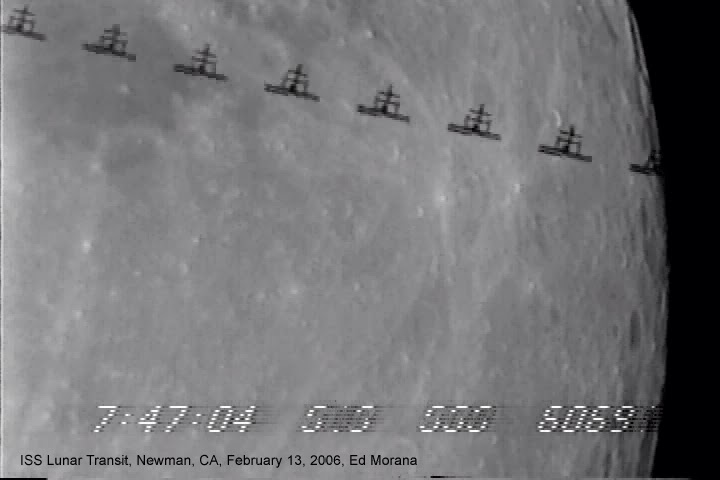
ISS TransitThat is where amateur astronomers come in.  Thanks to the magic of the Internet, you can find where in the sky to look to see events like meteor showers, conjunctions (eg. two planets appearing to come together in the sky), and transits (eg. a planet passing in front of the sun).  I am particularly fond of SpaceWeather.com, which also lets you know when to look out for aurorae and posts some amazing images.  One of those images that I remember in particular was of a transit of the International Space Station.  The picture I remember was of a transit across the sun rather than the moon (there are actually quite a few of those in Google images results), but the interesting part is that these were done by an amateur using a small (10") telescope and a video camera.  He even has a website dedicated to ISS transits with several more photos and videos.

M31 AndromedaProbably the best website for an introduction to astrophotography is called Catching the Light.  It includes guides on how to use a DSLR for astrophotography, processing images in Photoshop, and image galleries (which are definitely worth checking out even if you aren't interested in the rest).  I picked out my favorite picture from the DSLR showcase gallery to show just how good these look.  Yes...that is an amaeur image (of M31 Andromeda).  The description of the equipment used, exposure, processing, etc. is here if you are interested.
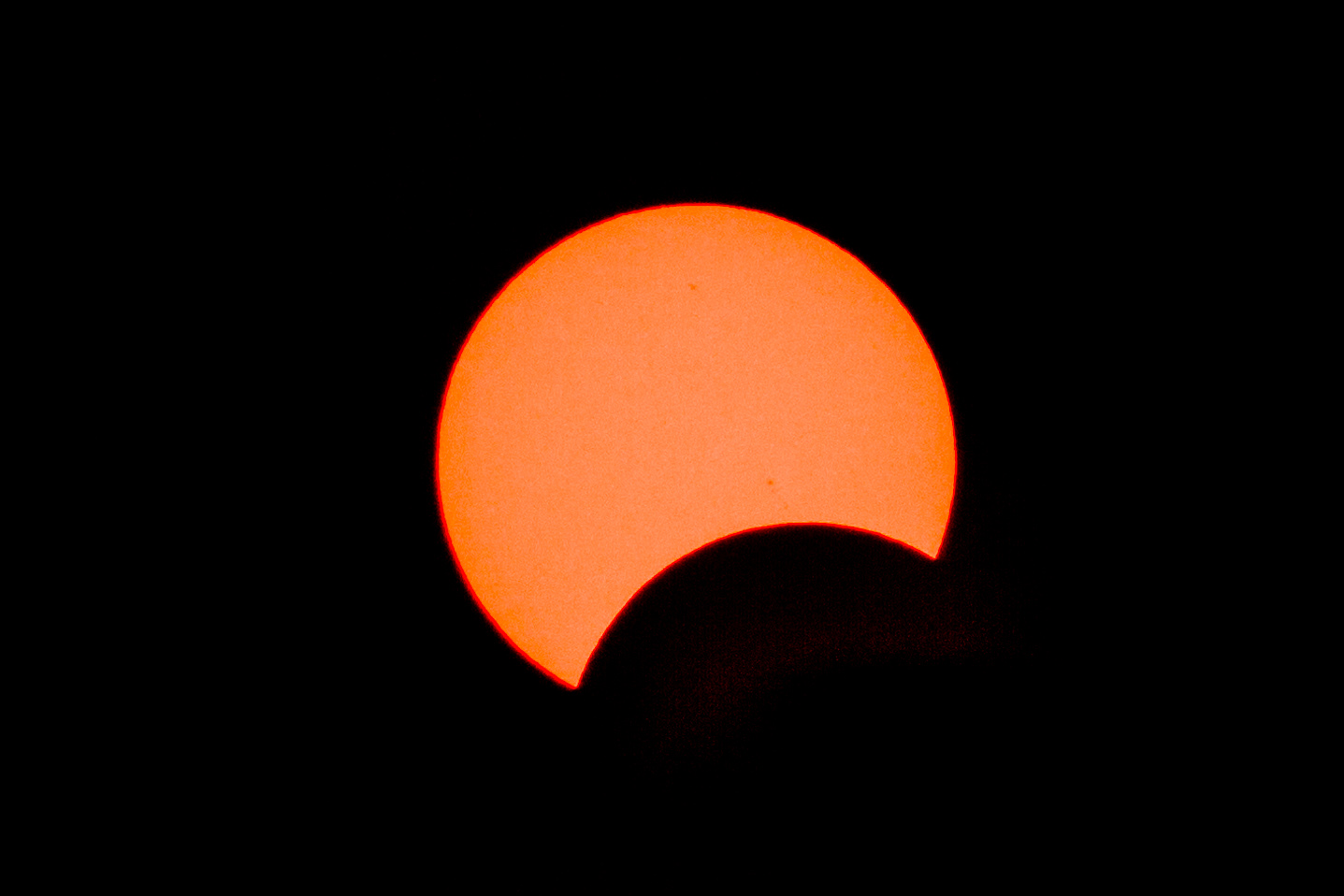
Partial Solar Eclipse
My own attempts at astrophotography have been rather less successful, to say the least.  This could mostly be attributed to the fact that I attempt to use the lenses I already own rather rather than buying a proper telescope mount.  Given that fact, the only truly successful shoot I've had was during a partial solar eclipse on May 20, 2012.  A word of caution:  Don't point your camera directly at the sun!  I was using an R72 filter, which blocks out light with a wavelength shorter than 720nm.  It looks nearly black because that is what is visible to the human eye.  Also, most cameras have a built-in filter to block out infrared, so almost no light was getting through, making it safe for me to take pictures of the sun.  Mostly to prove I can do better than a featureless photo of the sun, here is my 500px page, which is in desperate need of updating.

Thursday, February 6, 2014

Our earth, from space

This image was just released from NASA’s Curiosity rover on Mars:


Clicking on the image will bring you to the Unvierse Today article where you can continue to enlarge the image. Once you enlarge it, zoom in as far as you can and you will find the following image (or something very similar to it):


The bluish-white dot is Earth, is “us”. The slightly grey splotch beneath Earth is the Moon. Yes, our “large” satellite (in astronomy an object that is gravitationally bound to and orbiting another, larger object is referred to as a satellite). It really is just amazing if you think about it: there is a man-made machine ON ANOTHER PLANET (!) that just took a picture of us from space. For some reason that just blows my mind.

It reminded me of the image taken last summer by Cassini, the spacecraft orbiting Saturn:


This made me ponder about other images of Earth from space. I dug this up from www.planetary.org:


The picture caption on the site states the following:

“This picture of a crescent-shaped Earth and Moon – the first of its kind ever taken by a spacecraft – was recorded Sept. 18, 1977, by Voyager 1 when it was 11.66 million kilometers (7.25 million miles) from Earth. Image credit: NASA/JPL.”

We have come a long way since 1977, but it is still just as beautiful and incredible to see and ponder about. When I talk with non-astronomers about space, I always try to emphasize just how vast it is; space sure seems large (and empty) in these pictures.

Wednesday, February 5, 2014

Bill Nye the science guy vs creationism

I guess many of you heard about the debate between Bill Nye and Ken Ham.

I have linked the video below.
 http://www.youtube.com/watch?v=z6kgvhG3AkI
It is a debate of evolution vs creationism. Now it is sad that we still need to have this debate. When I heard this the first thing that came to my mind was, why  Bill Nye was doing it? I felt that this will give many people a viewpoint that evolution is a debatable topic. Still I decided to watch it.
Then I thought for some time and realized how important it is to have these debates. In CNN they talked about the same debate and showed a poll where 33% people in the US don't believe in evolution. While looking for information regarding this kind of debate, I found the gallup poll.
http://www.gallup.com/poll/21814/evolution-creationism-intelligent-design.aspx

In the  poll you can see still 46% of people believe that man was created in the current form. There are many such surprising results in the poll. So we can see still many people do not believe in evolution.
 I think most confusion arises due to the way words are used in scientific community and in general language. For example people think that scientific theory means something that is not a fact. Like hypothesis we propose in science. So it is important for a famous person like Bill Nye to convey these differences or at least try to do so. I thought Bill Nye did good job in this debate. If you listen to the debate, he never tried to attack a belief system, he just presented the facts regarding evolution to the general public. He gave good examples to prove evolution and age of earth. He tried to convince those 46% to at least think about scientifically proven theory of evolution and age of the earth.

Tuesday, February 4, 2014

The Eclipses of 2014


Even though it is February already, the year has only just begun. With that, comes the prime opportunity to mark our calendars for some pretty cool (predictable) events; eclipses.

Side note: There are some pretty cool unpredicted events that happen such as a Coronal Mass Ejection or solar flares that is directed toward Earth to cause the aurora in places like the northern states of the contiguous US. For those, you just have to watch and wait. Check out the Solar Dynamics Observatory webpage from time-to-time to check out how our sun is doing (and they have some cool images and videos too).

Eclipses: There will be 4 eclipses this year.

April 15th: Total Lunar Eclipse

This eclipse will be spectacular if you live within the dark shaded region of the image on the left (Europe, Asia and part of Africa) The level of shade indicates regions of visibility. The darkest areas are where you will see the total eclipse. The least shaded is where you will see no eclipse. Every where in between, you will see partial eclipses.

The times are given in Universal Time (UT). For example, Denver is in MDT which is -6 hours from UT during these eclipses. If we were able to see this eclipse, it would peak at 07:45:40 UT - 6 = 01:45:40 MST, which is at almost 2 in the morning.

April 29th: Annular Solar Eclipse

f you live in Australia or happen to be down in Antarctica during this event, you will see a rare one as this eclipse is classified as a non-central annular eclipse. According to Espenak and Messus (2006), out of the 3,956 annular eclipses occurring during the 5,000-year period (-2000 to +3000), only 68 of them or 1.7% are non-central.

This eclipse starts at 05:57:35 UT, peaks at 06:03:25 UT, and ends at 06:09:36 UT.


October 8th: Total Lunar Eclipse


Africa will take center stage for this beautiful eclipse. North America will be able to partially see this one, unlike the last one in April. In Denver, it will occur at 04:54:36. Better have some caffeine ready.


October 23rd: Partial Solar Eclipse

This eclipse will likely draw the most attention as it will be widely visible from the US (including Denver!). The eclipse begins at 19:37:33 UT, peaks at 21:44:21 UT, and ends at 23:51:40 UT. For the eastern half of the US, this will be a sunset eclipse. Get your cameras ready!

While this eclipse is only a partial solar eclipse, just remember always: NEVER STARE DIRECTLY AT THE SUN! No one needs to go blind. Make sure to wear "eclipse glasses" or use the pinhole projection technique.

Local observatories will likely have an open-to-the-public viewing events, so check your local news!


Information about these eclipses was gathered from the NASA Eclipse WebSite. Go check it out for further information about these eclipses and other cool space news!


Sunday, February 2, 2014

A shout-out for small telescopes

R-band CCD image of Mrk 501 from ROVOR.
I think this quote from Napoleon Hill (essentially the “founder” of personal-success literature) is a good starting point for this post: “If you cannot do great things, do small things in a great way.” I think this applies wonderfully to many of the not-greater-than-1-meter telescopes.

My undergraduate project was to build and operate a remote observatory. The Remote Observatory for Variable Object Research, or ROVOR, was located about 2 hours away from the main campus of Brigham Young University (BYU). It is only a 16-inch telescope, but the main purpose of ROVOR was to be able to sit constantly on an object for a long period of time. For example, part of my capstone project was dissecting sixty days of observation on a single blazar—a compact galaxy with a very active supermassive black hole in its center pointed face-on at us—known as Markarian 501 (Mrk 501); we totaled more than eighty images of the galaxy per night, making observations about every 3 minutes (we had another project going on during the first half of the night, so we typically had about four hours of observations every night we observed). And the big question is, of course, why?

BYU's ROVOR in Delta, UT.
A lot of time, effort, and money have been placed into the development of large telescopes. They are important in studying extremely faint and distant objects. So, as a disclaimer, I am not at all against larger telescopes—they are needed desperately (even the Hubble Space Telescope is a 2.4-meter scope)! However, the emergence of the “small and simple” telescopes is quite important.

The availability of smaller telescopes allows individuals and smaller organizations (such as universities, community colleges, and high schools) to have a working telescope at their fingertips. This allows undergraduate students to sit on a single object for months on end. These smaller telescopes have opened the door to the time-domain portion of astronomy. Simply, the time-domain is evaluating the brightness of an object over long and short time periods. My undergraduate advisor, Dr. J. Ward Moody, discussed the importance of this aspect of astronomy almost daily.

Take the Kepler spacecraft as an example. It is a 0.95 m space telescope that has confirmed more than 240 planets around other stars! (The video shows an animation of the "confirmed" planets in their respective orbits around their companion sun.) Its discoveries were made possible by viewing one part of the sky for years. And the point of the mission: to “[stare] at the same star field for the entire mission and continuously and simultaneously [monitor] the brightesses of more than 100,000 stars for at least 3.5 years, the initial length of the mission…” (Kepler mission QuickGuide). The concept of Kepler was to look for small, intricate changes in the light curve (the brightness of a star over a period of time) of a hundred-thousand stars. By doing so, Kepler has been able to detect hundreds of otherwise-unobservable planets around other stars. The mission says that much more is coming—and not just in planet searches.

Columbia Basin College's REMO, in Richland, WA.
My undergraduate work with Mrk 501 was looking for changes in the light curve of this blazar, ranging from ∆t = 3 min to 3 months. In galactic astrophysics, the shorter times scale fluctuations correspond to the physical size and mass of the central supermassive black holes. So, in essence, we were searching for details that only constant, frequent observing would be able to find. Additionally, I worked with a community college in western Washington (Columbia Basin College) that was able to purchase a similar telescope to ROVOR (the Robert & Elisabeth Moore Observatory). The work they were interested in was transiting bodies—another time-domain project.


In conclusion, big telescopes are great—we all need them in our observing work. But small telescopes have a niche in the time-domain (and others, such as bright objects). They do small things great. If you need something looked at frequently and constantly, try finding a small group that has access to their own telescope. I know a few.

Saturday, February 1, 2014

Scientist Highlight: Vera Rubin

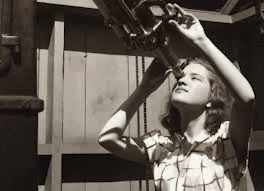
I've always found that it's helpful to have role models to look up to: when I was a kid and wanted to be an astronaut, it was Eileen Collins, the fist female shuttle commander.  (Her autographed picture is still on my wall in my old bedroom!)  When I started studying astrophysics, I learned about Vera Rubin, and I've always been inspired by her.

Dr. Rubin truly broke down barriers for women in astrophysics.  She attempted to attend Princeton for graduate school, but women were not allowed in their program at the time (in the late 1940s-early 1950s). Instead of letting this discourage her, she enrolled at Cornell, where she got her masters, and later received her PhD from Georgetown, where her thesis focused on the idea that galaxies formed in groups as opposed to being distributed evenly throughout the universe.  We know this to be true now, but at the time it was not a popular idea.


Dr. Rubin is most famous for her discoveries in galaxy rotation, which led to the idea of dark matter.  While studying the speeds of stars in the Andromeda Galaxy, Dr. Rubin realized that the speeds of the outer stars were not consistent with our understanding of Newtonian gravity.  This meant that there must be more matter in the galaxy than we can see -- which was named dark matter.  Of course dark matter is still largely a mystery to cosmologists, but it was Dr. Rubin's work that provided the background for this groundbreaking and important discovery.

When I did my first summer internship in astronomy research at the Carnegie Institution of Washington, we had a welcome lunch for the interns on the first day.  I sat down next to an elderly woman and we had a wonderful conversation about astronomy and how excited I was to begin my first research project.  At the end of the lunch, I asked her name, and she told me it was Vera.  I ran back to my office and looked her up -- and indeed, I had just had a conversation with Dr. Rubin, whose office was around the corner from mine that summer.  She was 80 years old then, and still came to work every day, as I imagine she still does.  She truly exemplifies what complete devotion to and love for your work looks like.

I had the chance to talk with her a few more times that summer.  When asked how she came to work at the Carnegie Institution, she said "well, I needed a job, and a lot of people weren't hiring women.  So I just knocked on the door and asked."  That kind of tenacity and fearlessness is incredible.  Although women in astronomy are still a minority, it's people like Dr. Rubin that broke down barriers to make it much easier for us today, and for that I am thankful.

Space snow

The off-and-on snow we’ve been getting in Denver has actually been pleasant. It’s like Mother Nature is fighting with itself: “I want it to be spring, but it’s really supposed to be winter…but I want it to be spring…but…” I’ll take what I can of the non-sub-zero temperatures.

And those temperatures I am referring to are typically in Fahrenheit, or °F. In astronomy (and physics in general), we commonly use temperature units of Kelvin. The Kelvin scale is significant because 0 K is “absolute zero”, or the point where all thermal motion has ceased. The scale itself seems a little strange at first (70 °F = 294 K; 32 °F = 273 K; and 0 °F = 255 K), but again, it is a very useful tool. It makes temperatures of objects “easier” to understand and reference.

Astronomy provides (probably) the greatest temperature extremes that are to be found. The center of the sun is about 15,000,000 K; the “surface” of the sun is “only” about 5,800 K; interstellar space sits at about 2.5 K. What is amazing is thinking about how our solar system was able to form from a massive cloud of cold gas and dust, that created a hot star in the center (the sun), that helped create a disk of material that accumulated into planets.

Anyway…where does the snow concept come into play in astronomy? An important feature of planet formation is where the planets formed. Since the temperatures around the central star, or in this case, our sun, are too hot for gasses to form ice (or liquid, then ice), then there must be a point that the heat from the sun is low enough for ices to form. The point at which this occurs is referred to as the “snow line”, or sometimes, the “frost line”. This is the point where gas and ice are able to “survive”, as shown in the figures.
From Sean Raymond's PlanetPlanet blog.
Subaru telescope press release in 2009.
The sun is so hot that as the solar system was forming, it pushed the gas and ice out towards the outer part of the solar system. It is there where we find the “gas” and “ice giants” (Jupiter, Saturn, Uranus, and Neptune). The inner planets are made up of mostly rocky material, or solid material that was not pushed out by the sun’s intense radiation. It is a parallel concept to think about the snow line on a mountain range, like this image of Mt. Sophris in western Colorado. You can see where the temperature/weather is suitable for snow formation.
Keith Cooper image of Mt. Sophris.
Understanding the distribution of material in the early solar system provides answers to how the solar system formed: frozen moisture is vital in helping dust stick together (to then form planets). Inga Kamp, an astronomer studying protoplanetary disks at the Kapteyn Institute, at the University of Groningen (Netherlands) explains it fairly succinctly here. Various molecules condense from a vapor to a solid at different temperatures, but water ice, for example, condenses at about 180 K; methane, on the other hand, condenses at about 40 K (Lodders 2003). Dust grains also have condensation temperatures and this is important because silicate rocks need to form in order to make rocky planets (condensation temperature for a silicate ~ 1400 K). Even in my disk research—where the disk I am studying is quite warm (around 550-1150 K at the edge)—it is important to understand these condensation temperatures so as to better comprehend the make-up of these astronomical objects.